- Utah Investor Report
- Posts
- 2025 Utah Market Review
2025 Utah Market Review
Both single family and multi-unit property finish the year UP compared to 2024; Delinquencies are rising due to hidden housing cost; SLC emerges as 2026 Housing Hot Spot

David Robinson
January 07, 2026

Utah Market Data
Single Family Homes
December 2025 & FY 2025 Market Overview - Single Family Homes
New Listings increased again in December, rising 12.9% from last year. For the full year, new listings are up 9.9%, showing that more homeowners are choosing to sell and inventory continues to rebuild.

Closed Sales were slightly higher than last year, up 2.2% for the month and 2.6% year-to-date. This shows that buyers are still active and able to close deals, even as the market slows compared to peak years.

Median Sales Price was up slightly for the month at $519,500, and is up 1.8% year-to-date finishing at $515,000. Prices are still trending higher overall, though the pace of growth has clearly slowed.

Inventory of Homes for Sale jumped 17.1% from last December, reaching just over 10,000 homes on the market. This increase in supply is giving buyers more options and reducing pressure on prices.

Bottom line: More homes are coming on the market, sales are holding steady, prices are rising more slowly, and inventory is rebuilding — all signs that Utah’s single-family housing market is moving toward more balanced conditions.
Multi-Unit Property (2+ units)
December 2025 & FY 2025 Market Overview - Multi-Unit (2+ Units)
New Listings rose sharply in December, up 30% from last year (65 vs. 50). For the full year, new listings are up 7.9%, showing that more multi-unit owners are testing the market as conditions slowly improve.

Closed Sales also increased for the month, up 18.9% compared to December 2024. However, year-to-date closed sales are down 1.7%, which tells us that while activity picked up late in the year, overall transaction volume in 2025 was slightly lower.

Median Sales Price jumped significantly in December, rising 18% year over year to $740k. On a year-to-date basis, the median price is up a more modest 3.7%, pointing to slower but still positive price growth overall.

Inventory of Properties for Sale increased meaningfully, climbing 33% from last December to 258 active listings. This growth in supply is giving buyers more options and contributing to a more balanced, less competitive multi-unit market.

Bottom line: More multi-unit properties are coming to market, prices are still higher than last year but growing more slowly, and inventory is building — signs that the multi-unit market is loosening and becoming more buyer-friendly compared to prior years.
Single Family Vs Multi-Unit Comparison:
Single-family and multi-unit markets in Utah are both seeing more homes come on the market, but they are moving in different ways. Single-family homes have steady sales, modest price growth, and rising inventory, showing a market that is slowly balancing but still supported by strong buyer demand.
In contrast, the multi-unit market is more uneven: new listings and inventory are rising faster, sales are slightly lower for the year, and prices are more volatile due to fewer transactions.
Overall, single-family homes look more stable, while multi-unit properties are adjusting more sharply to higher interest rates and investor caution.
Mortgage Rates & Financing
Mortgage Rates (as of Jan 7, 2026)
Mortgage rates are mostly flat to slightly lower to start the year. The 30-year fixed rate sits at 6.20%, basically unchanged from last week and down 0.90% from a year ago. The 15-year fixed is at 5.74%, also lower than last year, and FHA and VA loans remain in the mid-5% range with small month-over-month declines. Jumbo loans are at 6.35%, down a full 1.00% year over year, showing one of the biggest improvements.

10-Year Treasury Yield (as of Jan 7, 2026)
The 10-Year Treasury is holding near 4.16%, slightly below its recent levels and well under last year’s highs. Since mortgage rates closely follow the 10-Year Treasury, this stability is helping keep mortgage rates from moving higher.
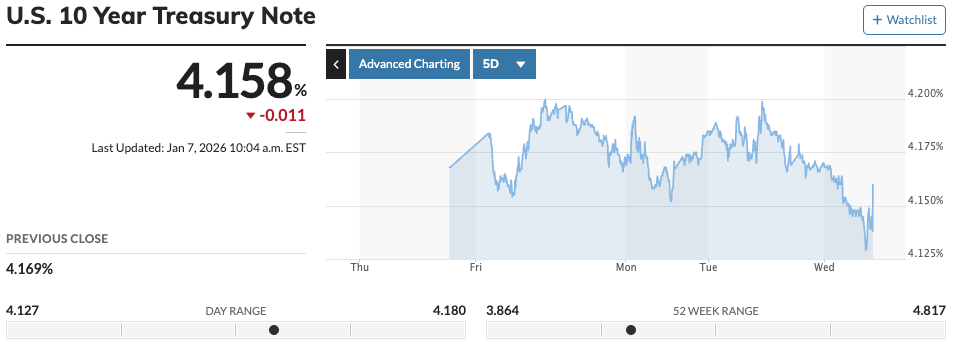
Bottom line: Rates have leveled off and are clearly better than they were a year ago. While borrowing costs are still elevated, the trend remains slowly favorable for buyers and investors heading into 2026.
Source: Mortgage News Daily

Headlines & Insights
FEATURED ARTICLE
Rising property taxes and homeowners insurance are quietly pushing up monthly housing costs across the country—and it’s starting to show up in higher mortgage delinquencies. According to housing analytics firm Cotality, fast-growing escrow payments may be one of the biggest financial risks homeowners face in 2026.
Escrow accounts are used by lenders to collect money for property taxes and insurance as part of a borrower’s monthly mortgage payment. While the loan itself may be fixed, escrow is not. When taxes or insurance rise, monthly payments can jump suddenly, catching homeowners off guard.
Nationwide, escrow costs are up 45% over the past five years. In some states, increases have been extreme. Between 2019 and 2025, escrow payments rose 77% in Colorado and 70% in Florida, driven by rapid home-price growth, expiring tax breaks, and sharply higher insurance costs tied to wildfires, hurricanes, and hailstorms. In many cases, insurance carriers are pulling out of high-risk states, reducing competition and pushing premiums even higher.

In several Midwest and Southern states, escrow now makes up a surprisingly large share of total housing costs. Nebraska, Texas, and Illinois top the list, where escrow payments account for roughly 44%–45% of a typical monthly mortgage payment. These states often combine high property taxes with rising insurance costs, even though home prices themselves may be relatively affordable.
The result is growing financial strain. Some homeowners are seeing monthly payments jump by hundreds of dollars, and others owe banks thousands to cover escrow shortfalls. This pressure is contributing to slower home sales, longer days on market, and more price cuts—especially in markets where affordability is already stretched.
Bottom line: Fixed-rate mortgages don’t protect homeowners from rising ownership costs. Taxes, insurance, and escrow are becoming a bigger part of the housing affordability problem, and buyers—and investors—need to factor these hidden costs into every deal heading into 2026.
Utah Headlines
Salt Lake City Emerges as a 2026 Housing Hot Spot – Salt Lake City is one of the top housing hot spots for 2026, according to a NAR report, with nearly 25,000 more households expected to qualify for a home as mortgage rates ease. Strong job growth, rising incomes, and more listings priced within reach of local buyers are making Utah’s largest metro especially sensitive to lower rates and better positioned for increased homebuying activity.
New Industrial Park Breaks Ground in Salt Lake City – PGIM and Dakota Pacific Real Estate are starting construction on a six-building, Class A industrial park in Salt Lake City’s Northwest Quadrant near the Inland Port. The nearly 450,000-square-foot project targets strong tenant demand in a tight industrial market and is expected to deliver new space starting in early 2027.
National Headlines
Rent Seasonality Is Broken – Apartment rents are falling earlier and staying softer longer because years of heavy apartment construction have created too much supply. With vacancies rising and units taking longer to lease, landlords in many markets are facing a very different rent cycle than in the past.
Migration Shifts Reshape Real Estate – More Americans are moving to smaller, more affordable markets instead of big cities, changing where housing and jobs are needed. This shift means commercial real estate investors may focus more on affordable housing, modest offices, and everyday retail in smaller markets rather than large urban projects.
Rates Hit a Yearly Low – Mortgage rates fell through the second half of 2025, with the average 30-year fixed rate ending the year at 6.19%, the lowest level since late 2024. While rates are still high by historical standards, even small declines are helping bring more buyers back into the market and could pull over a million households off the sidelines.
Jobs Data in the Spotlight – The first full jobs report of 2026 could move mortgage rates if it shows the labor market is slowing more than expected. A weaker report would likely push rates lower, giving buyers more leverage in a market where sellers still outnumber buyers.
Starter Homes, Smarter Cities – A new Realtor.com report highlights affordable Midwest, Northeast, and Southern cities as the best places for first-time homebuyers in 2026, led by Rochester, New York. These markets offer lower home prices, shorter commutes, and incomes that make buying a first home more realistic despite higher mortgage rates.

David Robinson
Principal Broker/Owner
Thinking about buying, selling, or exchanging investment property in Utah?